Energy and Water Benchmarks for Cassava Starch Factories: Where Efficiency Projects Usually Start
In cassava starch production, energy and water performance is rarely fixed by one machine or one setting. It is usually the result of root quality, washing discipline, rasping condition, slurry viscosity, separation behavior, recycle water control, and how hard the dryer has to work at the end of the line.
That is why a useful benchmark does not begin with a generic number. It begins with the factory’s own mass balance and the few process points where losses become visible.
Enzymesconnect works as an enzyme supplier for cassava starch processing with a practical focus: help plant teams stabilize slurry behavior, protect starch brightness, improve separation, and reduce avoidable energy and water load without adding complexity to daily operation.
For starch producers, processors and distributors: Enzymesconnect supplies cellulase, pectinase and amylase programs for cassava wet-end efficiency projects, wholesale and in bulk. Send the process target, current bottleneck, approximate quantity and delivery country, and we quote per order. Request a quote
Why cassava starch benchmarks vary so much
Two factories with similar installed equipment can show very different utility profiles. The causes are usually not mysterious:
- Root freshness and fiber content shift through the season.
- Soil load changes washing demand.
- Rasper wear changes starch release and fiber carryover.
- Slurry viscosity affects pumping, screening, and hydrocyclone performance.
- Recycle water quality changes separation stability.
- Dewatering performance determines how much moisture the dryer must remove.
- Wastewater load rises when starch and soluble material are not recovered cleanly.
A benchmark is useful only when it respects this variability. For cassava starch factories, the strongest efficiency projects usually start in the wet process, long before the final drying stage.
The first benchmark: water in, water reused, water discharged
Water is not just a utility in cassava starch production. It is a carrier, a separator, a washing medium, and a source of process risk.
A plant-floor benchmark should separate water into three practical buckets:
-
Fresh water entering the process
Track where fresh water is required for product quality and where it is being used because recycle water is unstable. -
Process water being recirculated
Monitor whether recycled water is helping the process or carrying fine solids, color bodies, foam tendency, or microbial load back into critical stages. -
Wastewater leaving the factory
Identify whether the discharge load is driven by true soluble material, starch loss, fiber loss, or poor separation discipline.
The goal is not simply to cut water. The goal is to cut the wrong water: uncontrolled dilution, unnecessary flushing, unstable recycle loops, and loss-driven discharge.
The second benchmark: energy by process pressure point
Energy in a cassava starch factory is often discussed at the dryer, but the dryer is only the final bill collector.
Before focusing only on heat demand, benchmark these pressure points:
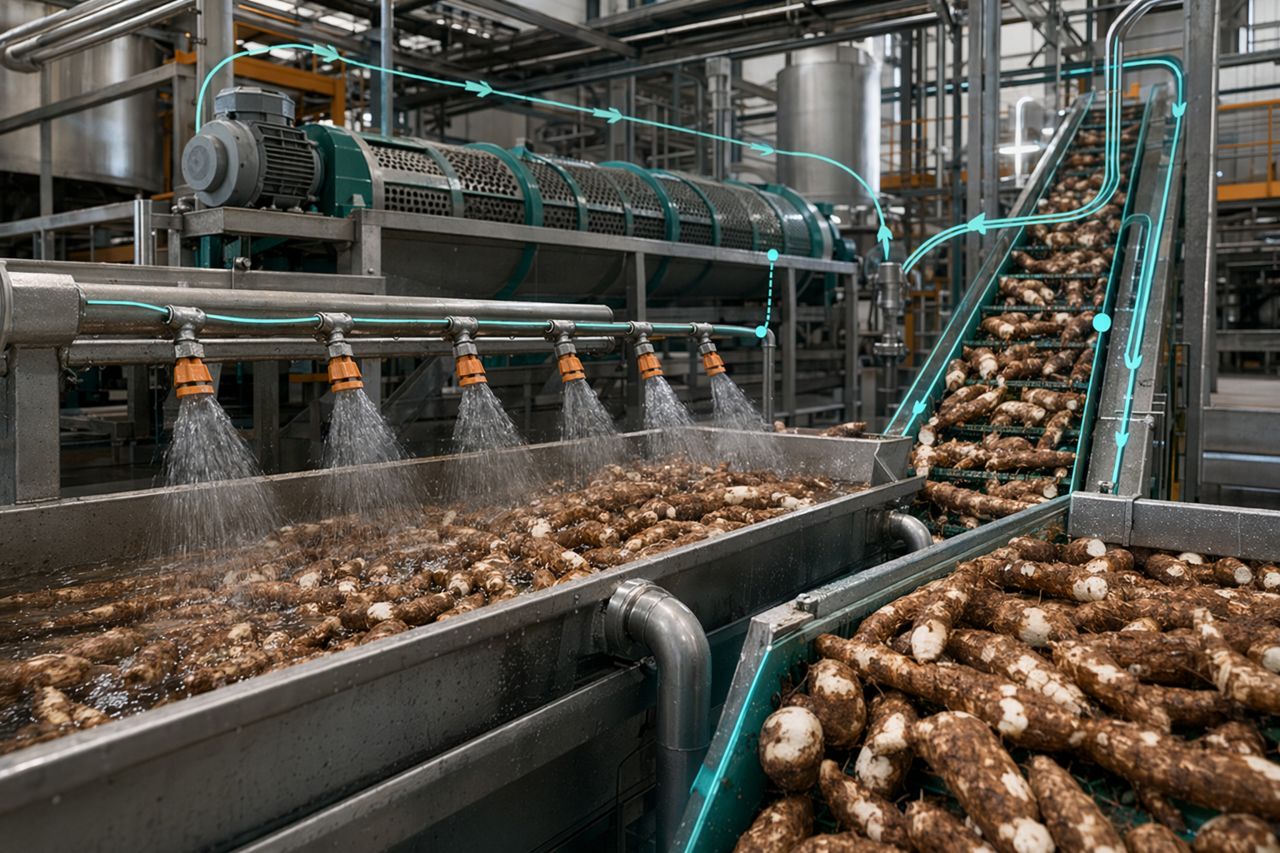
Washing and root preparation
Heavy soil load, inconsistent root feeding, and poor washing control increase water use and raise the load on downstream clarification. If washing is inconsistent, the rest of the factory compensates with more water, more cleaning, and more downtime.
Rasping and extraction
Rasper condition has a direct effect on starch release. When release is poor, operators often compensate with higher flow, longer residence, more screening load, or more recycle. That creates hidden energy and water penalties.
Slurry transfer and screening
Viscosity is a practical operating issue. Thick, unstable slurry can increase pump load, reduce screening efficiency, and push operators toward dilution. Dose discipline and slurry conditioning can help the line run with less corrective water.
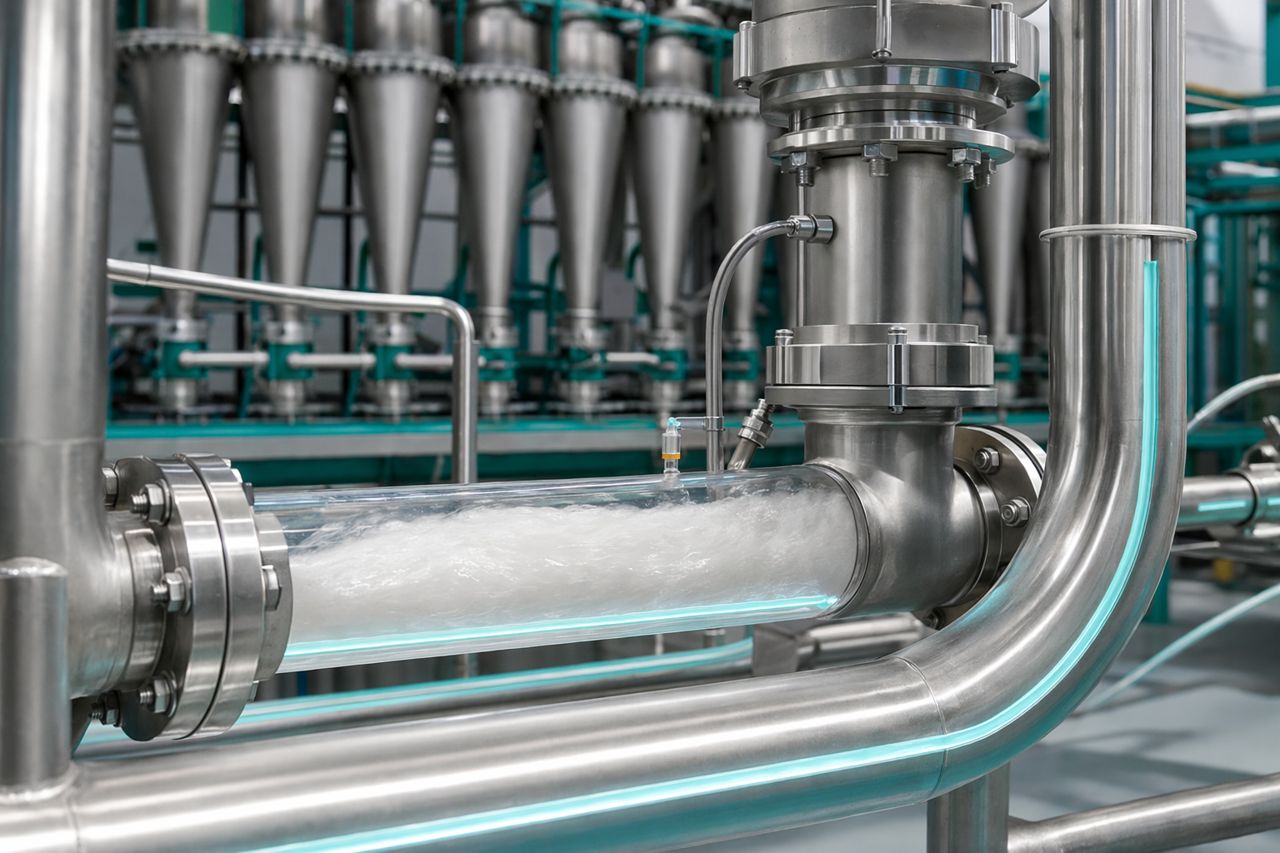
Hydrocyclone separation
When feed consistency shifts, hydrocyclone stages can lose sharpness. That affects starch recovery, protein removal, fiber carryover, brightness, and wastewater load. Stable slurry behavior supports stable separation.
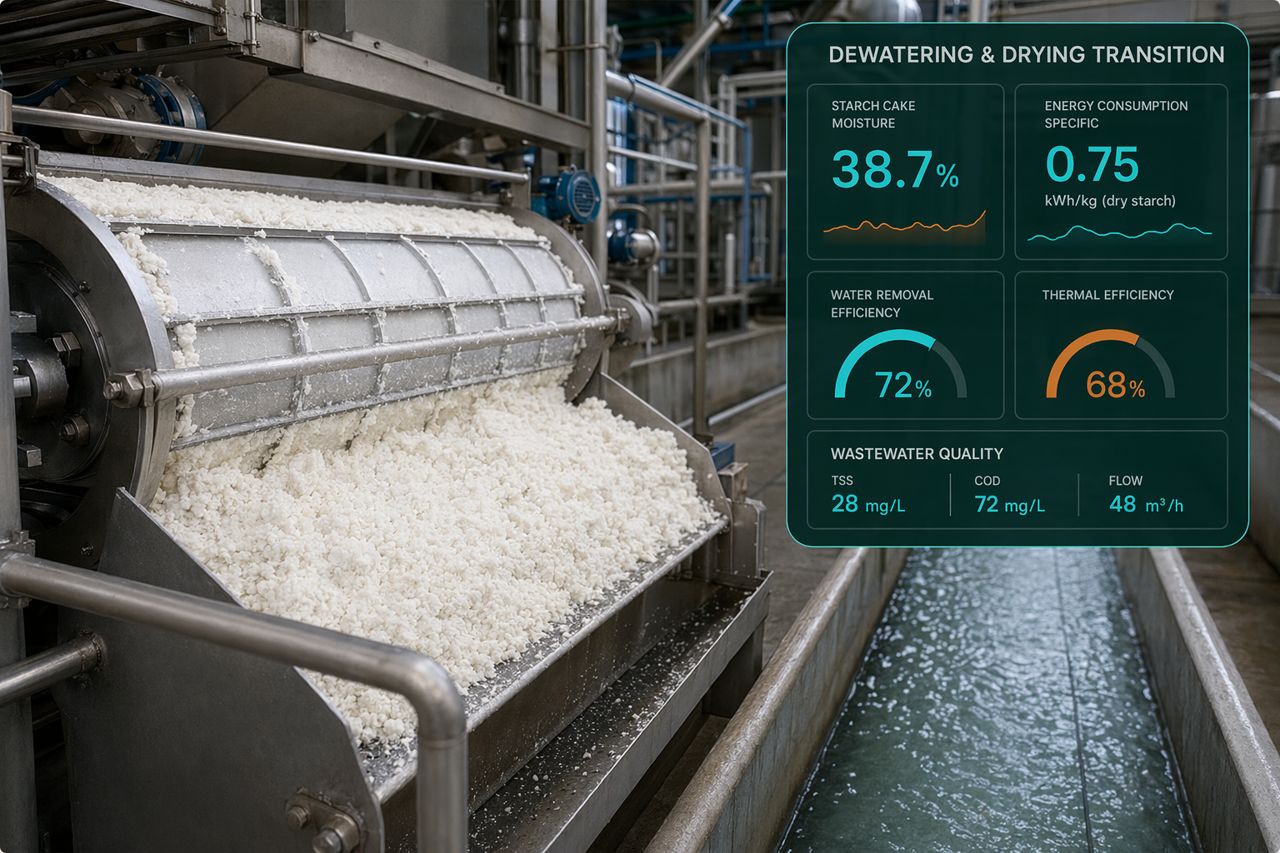
Dewatering and drying
Every point of moisture left after dewatering becomes extra work for the dryer. Improving upstream release, washing, and separation can reduce the burden on thermal energy without forcing the dryer team to solve a wet-end problem.
Where enzyme-supported efficiency projects usually start
Enzyme solutions are not a shortcut around process discipline. They work best when they are tied to a clear bottleneck and controlled within the factory’s operating window.
Typical starting points include:
- Slurry viscosity control where dilution has become the default correction.
- Starch release support where fiber structure limits extraction efficiency.
- Separation stability where fine solids and soluble carryover disturb hydrocyclone performance.
- Brightness protection where process water quality and residence time increase color risk.
- Wastewater load reduction where recoverable material is leaving with the effluent.
The commercial value is practical: less corrective water, fewer unstable shifts, cleaner separation, improved recovery discipline, and a lower burden on wastewater and drying systems.
A simple plant benchmark checklist
Before starting an efficiency project, build a baseline that operators, maintenance, QA, and procurement can all trust.
Track the following by shift and by root lot where possible:
- Fresh water intake by process area.
- Recycle water return points and visible quality changes.
- Slurry consistency before screening and separation.
- Pumping instability, foaming, or abnormal dilution events.
- Hydrocyclone pressure stability and separation response.
- Starch loss indicators in fiber and wastewater streams.
- Dewatering behavior before drying.
- Dryer load changes linked to upstream variation.
- Cleaning frequency and unplanned stoppages.
- Finished starch brightness and quality hold points.
This level of benchmarking helps separate real process improvement from seasonal noise.
How to avoid poor benchmark decisions
Efficiency projects can fail when teams chase the wrong target. Watch for these traps:
- Cutting water before confirming product quality impact.
- Treating wastewater as an end-of-pipe issue only.
- Expecting the dryer to compensate for poor dewatering.
- Using chemical or enzyme additions without a dosing governance plan.
- Comparing factories without adjusting for root quality and equipment condition.
- Ignoring operator behavior during upset conditions.
A reliable benchmark should support decisions on the plant floor, not just in a spreadsheet.
What Enzymesconnect brings to the discussion
Enzymesconnect supports cassava starch processors with enzyme programs designed around real factory constraints: variable roots, wet-end instability, brightness requirements, separation limits, and procurement risk.
Our approach is practical:
- Define the operating problem before recommending a product.
- Align enzyme use with existing process controls.
- Support trials with clear success criteria.
- Focus on yield, water discipline, separation performance, and wastewater load.
- Help procurement evaluate supply reliability, handling, and repeatability.
If your factory is benchmarking energy and water use, the best first step is to identify where the line is compensating: extra dilution, extra recycle, unstable separation, high discharge load, or dryer pressure caused upstream.
Request a quote
Planning a cassava starch efficiency project or reviewing enzyme options for your wet process? Wholesale and bulk supply for starch factories and resellers: send your process target, current bottleneck, approximate quantity and delivery country, and Enzymesconnect will reply with a practical recommendation and quote for your factory conditions.